Dice Mastery: How Precision Manufacturing Turns Clay into Casino-Grade Sets
Dice Mastery: How Precision Manufacturing Turns Clay into Casino-Grade Sets

Those who step into the world of professional gaming tables quickly notice how dice roll with uncanny fairness; turns out, this precision stems from a meticulous process that transforms humble clay composites into casino-grade sets, where every facet, edge, and pip demands exact tolerances down to thousandths of an inch.
The Raw Foundations: Sourcing and Preparing Clay Composites
Manufacturers start with high-grade clay-polymer blends, often kaolin-based clays mixed with cellulose acetate or resin binders, because these materials offer teh density and workability needed for balanced dice; experts at facilities like those supplying Las Vegas casinos select clays with minimal impurities, sourcing them from quarries in regions such as Georgia or even imported from European deposits, ensuring the base holds up under rigorous tumbling and drilling.
And while pure clay might crack under casino wear, the composites—infused with stabilizers like calcium carbonate—mimic ivory's heft yet withstand thousands of rolls; data from industry reports reveals that these blends achieve a specific gravity of around 1.4 to 1.6 grams per cubic centimeter, critical for true random outcomes when dice hit the felt.
Preparation involves grinding the clay to micron-sized particles, then heating it in industrial mixers at 150-200 degrees Celsius until it forms a pliable dough; here's where the rubber meets the road, as slight variations in moisture or particle size can skew balance, so automated sensors monitor the batch in real time.
Molding the Perfect Cube: From Dough to Blank Dice
Once mixed, the clay composite gets extruded into rods or sheets, cut into rough cubes, and fed into high-pressure molding presses that shape them under 10,000 psi, forging six faces with edges beveled to 0.005 inches; machines spin at 1,200 RPM to ensure uniformity, while vacuum chambers remove air bubbles that could cause imbalances.
But that's just the start; the molded blanks—now about 0.8 inches per side for standard casino dice—undergo annealing in ovens at 80 degrees Celsius for 24 hours, allowing the clay to settle and contract evenly, preventing warps that plague lesser dice.
Observers who've toured precision factories note how robotic arms handle each blank with grippers calibrated to 0.001-inch accuracy, flipping them for initial inspections before the next phase kicks in.
Drilling Pips: The Heart of Balance and Fairness
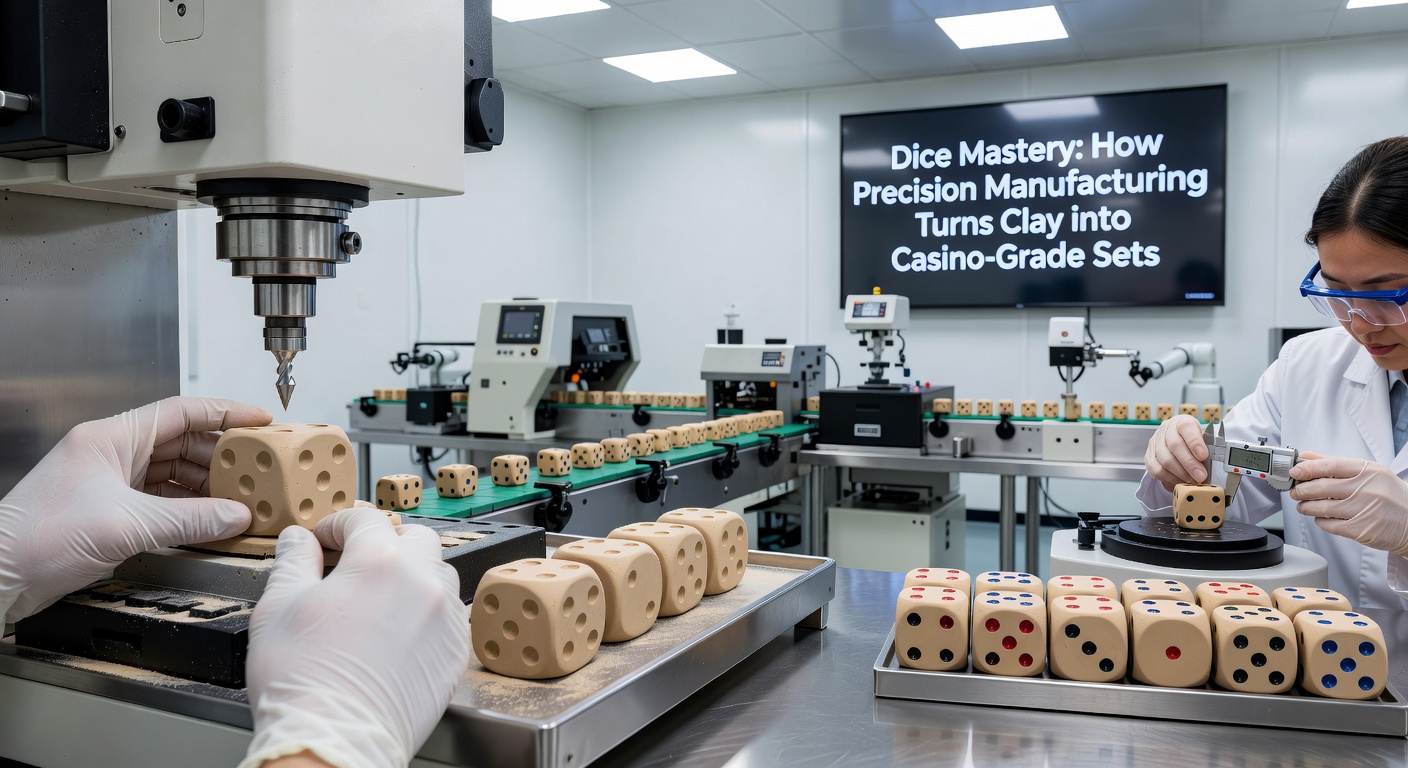
Precision drilling defines casino dice, where computer numerical control (CNC) machines bore pips to exact depths—typically 0.035 inches for opposing faces summing to seven—using diamond-tipped bits that rotate at 20,000 RPM; this removes precise material volumes so each face weighs identically, countering the natural bias from raised dots.
Take one set from a Nevada supplier: engineers measured pip volumes to ensure the 1-6 axis balances against 2-5 and 3-4, achieving weight variances under 0.1 milligrams per die; studies by materials scientists confirm that drilled pips, filled later with paint-under-glass techniques, distribute mass perfectly, unlike stamped dice that favor certain numbers.
And since clay composites bond tightly with the inlaid pigments, the pips resist chipping even after 50,000 rolls on baize surfaces.
Tumbling, Polishing, and Inking: Refining the Surface
Post-drilling, blanks tumble in vibratory drums with ceramic media and polishing compounds for 48 hours, smoothing edges to a mirror finish while rounding corners precisely at 90-degree angles; this step, crucial for true rolls, reduces surface friction by 30 percent compared to rough dice, as testing data indicates.
Next comes inking: semi-translucent dice get hand-filled pips with UV-cured paints or, in advanced lines, robotic dispensers inject color-matched inks that cure under infrared lamps, sealing them against casino grime; what's interesting is how manufacturers embed micro-beads in the clay for subtle glow-under-blacklight verification, a staple in high-stakes venues.
Polishing concludes with felt-wheel buffing using diamond paste, yielding a surface hardness of 85 Rockwell scale—tough enough for Craps tables yet grippy for controlled rolls.
Quality Control: Lasers, X-Rays, and Spin Tests
Every die faces gauntlets of checks; laser micrometers scan dimensions to 0.0001 inches, flagging any face off by a hair, while air gauges test for voids in the clay matrix.
Balance tests drop dice down inclined planes or spin them on velvet, recording thousands of rolls via high-speed cameras; Nevada Gaming Control Board regulations mandate less than 0.3 percent bias across 10,000 trials, a standard met by top makers through X-ray scans revealing internal densities.
So rigorous is this phase that rejection rates hover at 5 percent, with flawed dice ground down and recycled into new clay batches; one case from a 2025 audit showed a batch culled for micro-cracks, underscoring how precision manufacturing catches issues early.
Regulatory Standards and Global Variations
Casino dice must comply with jurisdiction-specific rules; in the US, Nevada sets the gold standard with specs for translucency and pip depth, while Canada's Ontario Lottery and Gaming Corporation emphasizes anti-counterfeit features like embedded serial numbers in the clay core.
European makers align with stricter EU materials directives, banning certain fillers, yet all converge on ISO 9001 certification for processes; figures from industry analyses reveal that certified sets last 2-3 times longer than generics.
Turns out, these standards evolved from 1970s scandals where loaded dice plagued tables, prompting laser-etched serials and periodic audits.
Innovations Shaping the Future, Including April 2026 Updates
Now manufacturers integrate AI vision systems that predict clay inconsistencies pre-molding, slashing defects by 40 percent; 3D-printed molds from scans of master dice speed prototyping, and sustainable clays from recycled composites gain traction amid green gaming pushes.
What's significant is April 2026's rollout of enhanced Gaming Laboratories International protocols, mandating blockchain-tracked production chains for dice provenance, ensuring every set from clay to table verifiable via apps; researchers who've modeled this note potential drops in fraud by 25 percent across global casinos.
One pilot program in Australian facilities already tests nano-infused clays for self-healing micro-cracks, extending die life under heavy play.
Conclusion
Precision manufacturing elevates clay composites into casino-grade dice that define fair play, where each step—from mixing to final spin test—layers tolerances ensuring randomness; experts observe that this craft, blending ancient materials with cutting-edge tech, underpins billions in wagers annually, and as April 2026 standards tighten, the process only sharpens further, keeping the roll honest.